SimStadt
Description
SimStadt is an urban simulation environment actively developed at HFT Stuttgart. It originated from a research project completed (SimStadt), followed by SimStadt 2.0 (final report in German here).
SimStadt v2 has been released, and is available here.
SimStadt uses CityGML data of real urban environments for energy analyses of buildings, city quarters, whole cities and even regions. The application scenarios range from high-resolution simulations of building heating requirements and potential studies for photovoltaics to the simulation of building refurbishment and renewable energy supply scenarios. Recent developments include the modeling of urban trees, detailed shadowing calculations, load profile generation, energy grid simulation, heat storage simulation, and the use of PVGIS as the default weather data source.
SimStadt has been open-sourced, with an MIT License, in September 2026.
SimStadt Next, 17th-18th September 2026, Stuttgart
- SimStadt Next, 17th-18th September 2026 SimStadt Next – Urban Energy Simulation for Sustainable and Resilient Cities, @HfT Stuttgart.
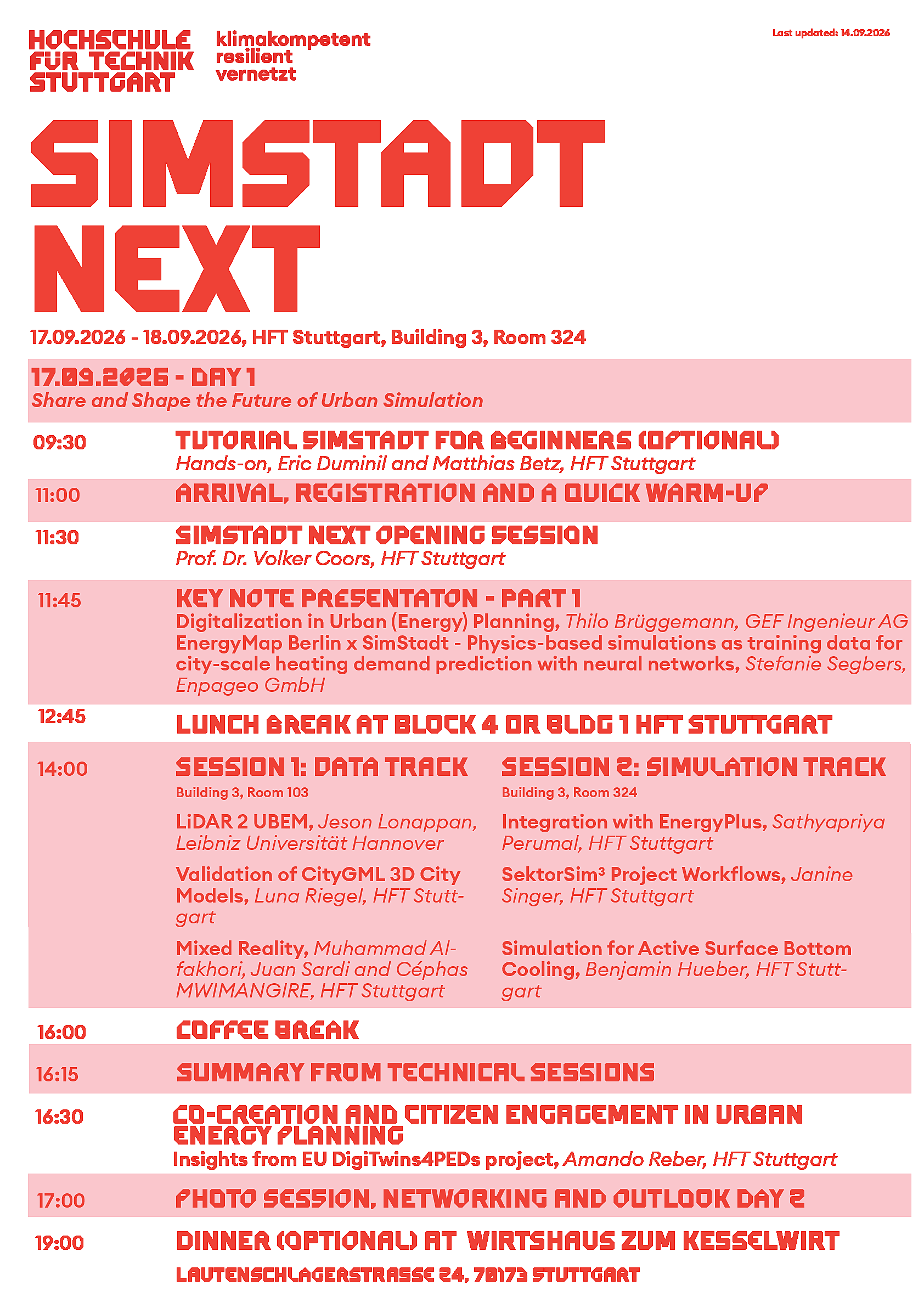
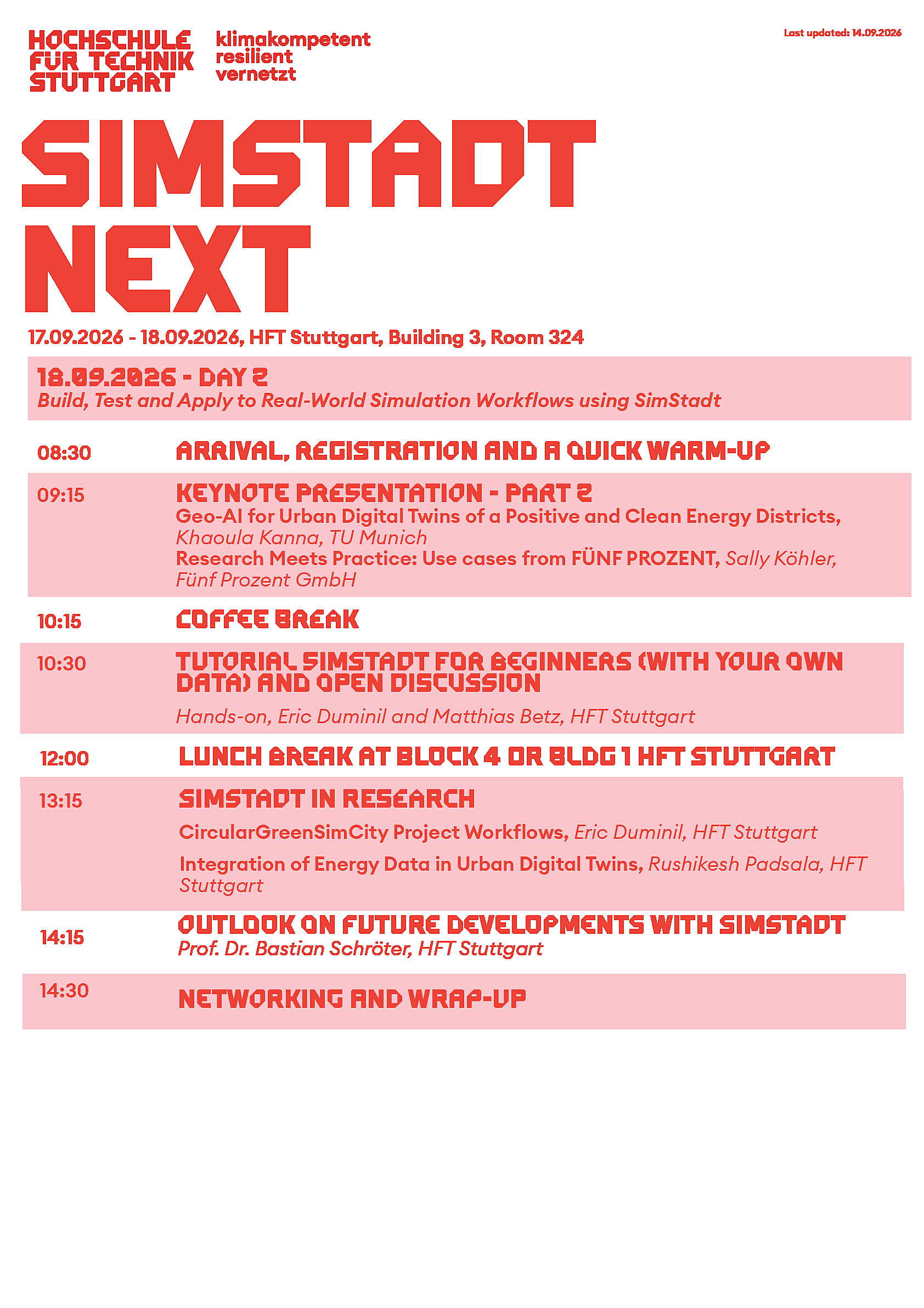
Do you want to explore how urban simulations and urban digital twins can make cities more sustainable, efficient, and resilient? Join us for two days to advance your knowledge in urban energy simulation and visualization through talks and hands-on learning sessions.
SimStadt Next brings together the community around SimStadt, an urban simulation environment developed at HFT Stuttgart. Over two days, students, researchers, developers and practitioners will demonstrate how SimStadt is being applied and further developed through current research projects and real-world use cases.
The programme features hands-on tutorials for beginners, keynotes, presentations, discussions and interactive sessions covering topics such as 3D city models, Geo-AI, urban digital twins and their integration into SimStadt-based workflows.
The event is aimed at Master’s students, PhD candidates, researchers, software developers and practitioners who want to discover SimStadt, apply it in their work or contribute to its future development together with the community.
- Optional: A “SimStadt for Beginners” hands-on tutorial will take place on 17 September from 09:30 to 11:00.
- The main event begins at 11:00 with arrival and registration, followed by the official opening at 11:30.
Dates: 17–18 September 2026
Venue: HFT Stuttgart, Building 3, Room 3.324
Language: English
An overview of all presentations, workshops, and program highlights is available in our program: SimStadt Next Agenda.pdf
Registration is free of charge, and a complimentary light lunch will be provided on both days.
What's new?
- SimStadt has been open-sourced, with an MIT License.
- SimStadt should now work on macOS (Apple Silicon)
- Detailed shadow analysis
- Green-water workflow for urban trees
- CSV export available from both CLI and GUI
- Automatic quarter archetype assignment
- CityGML parser migrated to citygml4j 3
- All example/test CityGML datasets are now based on open data
Projects
SimStadt is currently used in multiple research projects, including:
- SektorSim³ - Mobility, energy, and heat transition in urban districts, studying interactions between heat pumps, photovoltaics, and electric mobility.
- CircularGreenSimCity - Holistic resource-efficient analysis of urban districts, covering building materials, green infrastructure, water, energy, and mobility.
- Ind-Supply - Climate and resource-optimized heat supply for industrial areas, developing digital planning tools for sustainable heating solutions.
- CoolingMap - Creation of a building-specific cadastre for the analysis and forecasting of cooling requirements in exemplary urban regions of Germany using AI image recognition, building modeling, neural networks, and geoinformatics.
- DigiTwins4PEDs - The main concept of the DigiTwins4PEDs project is to use Urban Digital Twins as a digital representation of the real world, opening up a wide range of possibilities for modeling the energy aspects of cities.
- FlexPED - The aim of FlexPED is to develop an open and intelligent energy data and energy flexibility management system for Positive Energy Districts (PED). The project involves the use of modern tools such as artificial intelligence, agent simulations, and real-time data integration within a next-generation urban digital twin platform.
- EnergyMap Berlin - The objective of EnergyMap is to develop, establish and evaluate a database-supported multiuser/multisource application including an online platform for the creation of a building-specific digital heat register for the building stock of the state of Berlin.
- ASCEND - ASCEND aims at creating Positive Clean Energy Districts (PCEDs) and turning them into a default solution in European cities to mitigate the effectsof climate change and enable citizens to live in inclusive, resilient, and smart communities., @ TU München